Prickly Pear - From Mexico to Sicily
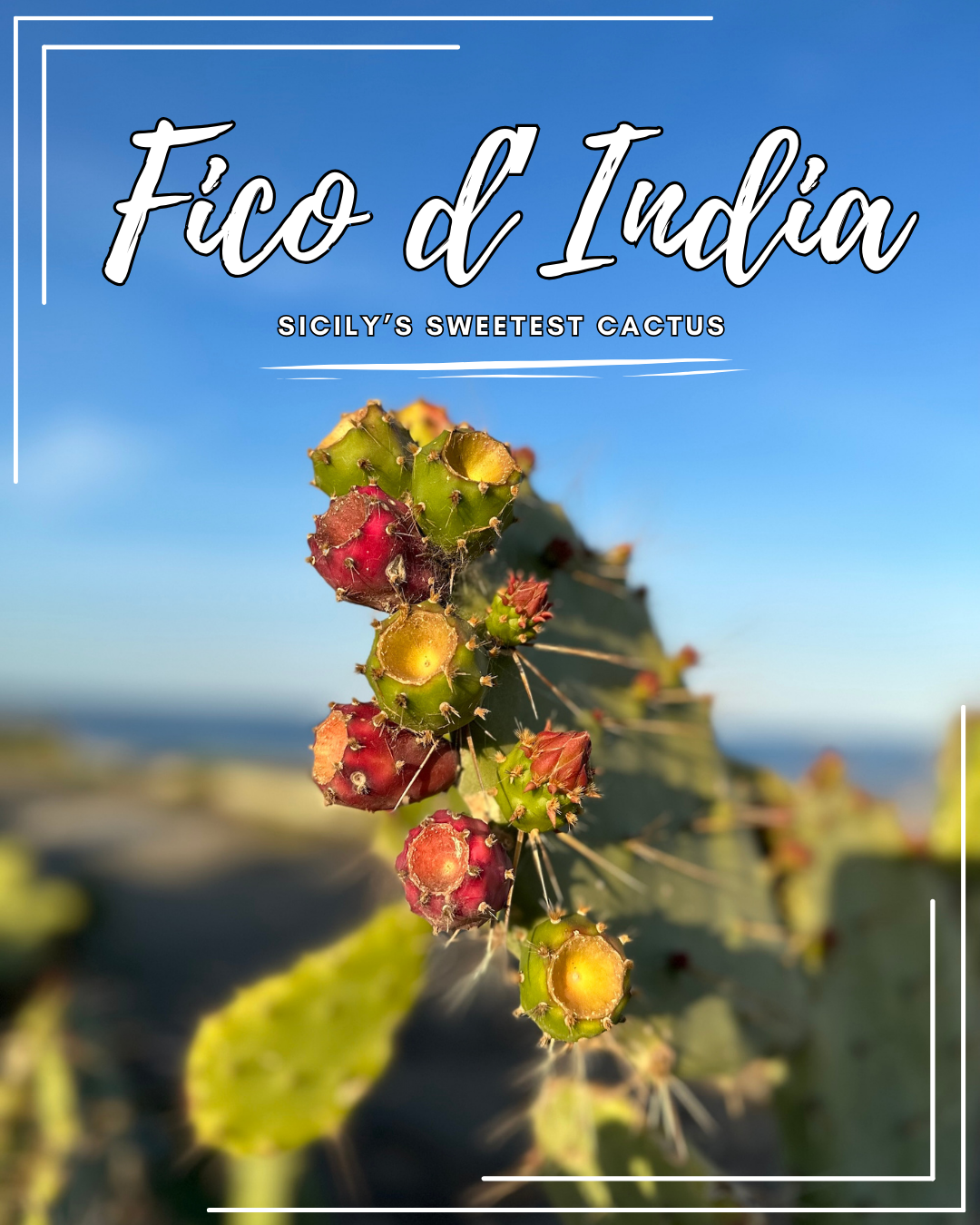
If there is one plant that seems to shout Sicily! from every hillside, roadside and crumbling stone wall, it’s the prickly pear, Opuntia ficus-indica, or as the locals call it, fico d’India.
With its enormous green paddles stacked like cartoon pancakes and its jewel-coloured fruit glowing in late summer, the prickly pear has become one of the most recognisable symbols of the Sicilian landscape. You’ll see it framing baroque towns, clinging to cliffs above the sea and growing quite happily where nothing else seems able to survive.
And yet, like so many things in Sicily, it’s not actually native.
🌍 From Mexico to the Mediterranean

The prickly pear originates in Mexico, where it is so deeply woven into the culture that it even appears on the national flag. It was brought to Sicily by the Spanish in the 15th century, and the plant took to the island immediately.
It loves heat, laughs at drought and thrives in rocky, poor soil, which makes Sicily’s sun-baked countryside pretty much perfect. Over the centuries it has completely naturalised, becoming so visually tied to the island that most visitors assume it has always been here.
It hasn’t, but it feels like it belongs.
🍈 Eating the fico d’India

The fruit, often called tunas, are oval and come in shades of yellow, orange, red and deep purple. At markets you may hear stallholders shouting out “bastardoni!” (roughly translating to big bastards). Don’t be offended, they’re talking about the size of the fruit, not the customers.
When ripe, prickly pears are sweet and extremely juicy, with a texture somewhere between watermelon and pear, though filled with tiny crunchy seeds. They’re eaten fresh, but also turned into jams, jellies, liqueurs and, of course, refreshing summer granita. 🍧
Less well known to visitors is that the young paddles, called cladodes, are also edible. Once the spines are removed, they can be sliced and used in salads and traditional dishes, particularly in rural cooking.
Yes, the cactus is doing double duty.
💪 A humble superfood

Beyond being tasty, the prickly pear has long been valued for its health benefits. It is rich in vitamin C, antioxidants and fibre, helping with digestion, hydration and blood sugar regulation.
In traditional Sicilian remedies it has been used to soothe inflammation and support skin health, practical folk medicine from a plant that grows almost everywhere.
Not bad for something covered in spikes.
🌋 A serious agricultural business

While prickly pears feel wild and untamed, they are also big business in parts of Sicily. The most famous production area lies on the slopes of Mount Etna, where volcanic soil gives particularly sweet fruit.
Here, the Ficodindia dell’Etna D.O.P. (Protected Designation of Origin) certifies quality and origin, and farmers carefully prune, cultivate and harvest the plants, often by hand, before exporting across Europe and beyond.
So yes, that scruffy-looking cactus patch may actually be a carefully managed orchard.
🔥 A natural firebreak

There is another very practical reason you will often see prickly pear planted along the edges of fields and around houses. It contains a high percentage of water.
That makes it a surprisingly effective natural firebreak, helping to slow or stop the spread of summer wildfires. In a hot, dry landscape, that is no small advantage.
Sicily has always been good at finding ways to make nature work for survival.
🎨 A symbol of Sicilian resilience

More than anything, the prickly pear has become a cultural icon. It is painted, sculpted, baked into pastries, turned into ceramics and woven into folklore. You will find it decorating balconies, garden walls and kitchen tiles across the island.
It thrives where other plants give up. It survives neglect, heat and poor soil. And it keeps producing fruit year after year.
For many Sicilians, it quietly represents something very familiar: resilience, stubbornness and the ability to flourish despite difficult conditions.
Which, when you think about it, makes it a pretty perfect symbol of Sicily itself.